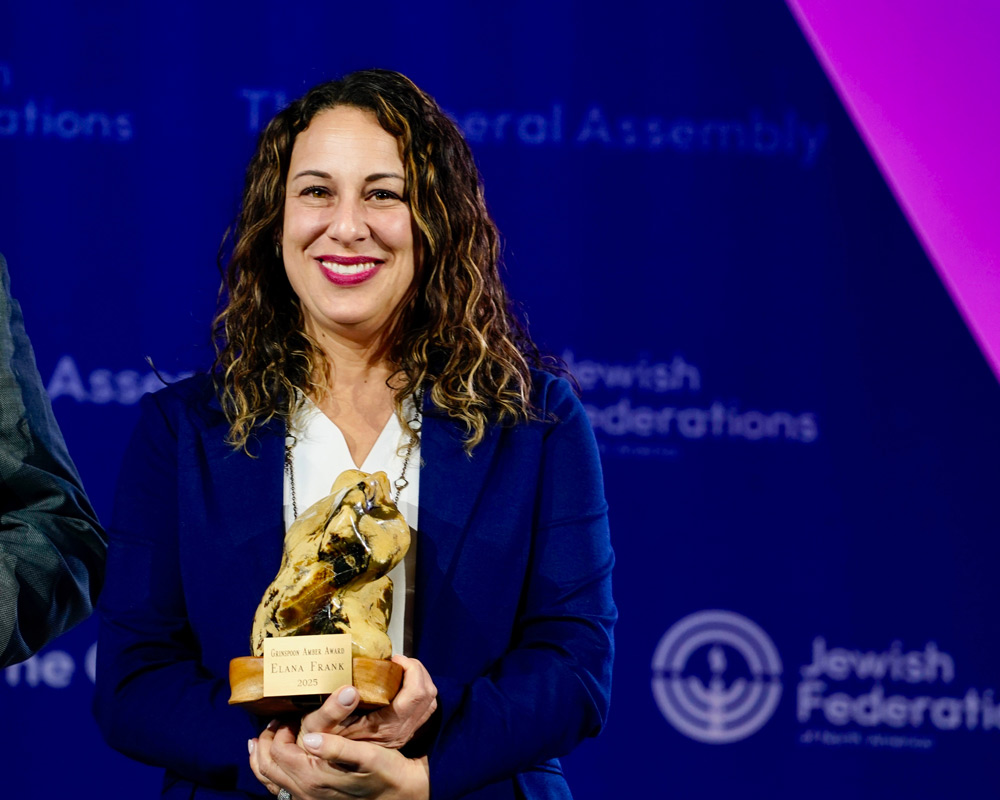
The Grinspoon Amber Awards, established in 2024, recognize and celebrate five individuals annually who have made outstanding contributions to Jewish communal life. Recently at the Jewish Federations of North America General Assembly, the Harold Grinspoon Foundation recognized the award’s inaugural winners: Rabbi Ana Bonnheim, Jeremy Burton, Jonathan Falk, Elana Frank, and Michelle Koplan.
Now, as of January 1, 2026, nominations are open for the 2026 Grinspoon Amber Awards. The nomination window will remain open until February 28, 2026.
Each 2026 Grinspoon Amber Awards recipient will receive a $10,000 prize and the opportunity to “pay it forward” by selecting two individuals doing impactful work in Jewish life to receive Peer Recognition Grants of $2,500 each. This distinctive feature of the award is intended to foster a ripple effect of gratitude, mentorship, and shared celebration across the Jewish communal field.
Learn more about the 2026 nomination criteria and nominate an outstanding Jewish communal professional here.
In honor of the open nomination window, the Harold Grinspoon Foundation is running a series of Q&A’s with the 2025 winners, continuing with Elana Frank.
Elana Frank has more than 20 years of experience working with nonprofits in a range of areas, including fundraising, marketing, community outreach, volunteer recruitment, board development, and program development. After personally experiencing the pain and loneliness of infertility, yet noticing how lucky she was to have had her journey begin in Israel, where fertility treatments are free, Elana was inspired to help others. The high cost of treating infertility, as well as a lack of education about, and lack of access to treatments were tremendous obstacles to addressing this “unspoken” issue in the Jewish community. Elana rallied countless like-minded people and created the Jewish Fertility Foundation.
“During infertility—a tender, critical time—JFF makes sure people feel seen and included inside Jewish life,” shared Elana. “Sometimes that looks like ‘a hug from the Jewish community’—practical help, compassionate language, and warm handoffs. Then, as families are ready, we lovingly pass the baton into the wider ecosystem: PJ Library (a beautiful HGF gift), the JCC, jbaby programs, synagogues, and more. For some, it even means connecting them for a ninth-month mikvah dunk—and introducing that cultural tradition when it feels meaningful to them. In practice, it’s moving from pain to participation, from isolation to kehillah, guided by chesed and kavod—and it’s exactly how we build a vibrant, connected Jewish future.”
You were nominated for the inaugural cohort of the Grinspoon Amber Awards. What was your reaction when you found out you had been nominated, and were invited to apply?
I felt deeply humbled and grateful. More than anything, I was energized by the chance to spotlight an often quiet, yet harsh, reality in our world: across the Jewish community—where 1 in 6 individuals face infertility—high treatment costs, profound emotional strain, and limited culturally relevant resources delay care, drain savings, and isolate families just when they most need support. Being nominated felt like permission to lift up those stories with care and dignity.
When I learned I was a winner, I became immediately aware that this recognition belongs to many. I thought first of our clients and our staff—the heart of JFF—who show up every day with compassion and excellence. I also thought of our volunteers, support group therapists, fertility doctors, and community partners who walk with families through vulnerable moments. Awards matter only if they widen the circle of support; my first instinct was to use the visibility for impact, not applause. I’m especially grateful to the philanthropic partners and individual donors who have sustained our work.
What do you find most meaningful about working in the Jewish professional world?
I’m inspired by how our ecosystem believes in Jewish entrepreneurs and backs ideas with coaching, community, and impactful support. Fellowships have been my scaffolding: UpStart’s UpSpring Growth-Stage Venture Accelerator, JWI’s Jewish Communal Women’s Leadership Project, the Jewish Women’s Fund of Atlanta’s Agents of Change Training (ACT), and now Project Accelerate. Each invested in my leadership—and in JFF’s vision—well before there was a spotlight, providing mentors, peers, coaches, funding, and practical tools to turn a kitchen-table idea into powerful, sustainable long-term impact. That vote of confidence is what I find most meaningful.
One component of this award is the Peer Recognition Grant. You were able to select two individuals to whom you could “pay it forward” with gifts of $2,500 each. Can you share about the people you're choosing and why?
I’m honored to recognize two partners whose quiet leadership strengthens the health and future of Jewish families all over the country. First is Elana Silber, the CEO of Sharsheret, for ensuring Jewish individuals and families facing breast/ovarian cancer receive culturally competent support and navigation, often intersecting with fertility decisions and emotional care.
Next is Matt Goldstein, the CEO of JScreen, for expanding access to genetic screening and education, empowering couples to make informed choices that safeguard the health of future generations. Together, they address health needs that directly shape Jewish family building—work that complements JFF’s mission.
What is an accomplishment that you're truly proud of?
My three boys. Infertility is a club no one wants to join. I remember the years in Israel—fielding intrusive questions, wondering if it would ever happen—then the awe of finally holding two babies, knowing I had more love to give, and finding a way to welcome a third through embryo donation.
Today I get the sweetest kind of ordinary: cooking dinner, tidying up baseball gloves and socks from every corner, reminding someone to actually aim at the toilet, negotiating homework and Bar Mitzvah practice, the constant wrestling, bedtimes, and screen time negotiations. It’s messy and loud and perfect. I can’t believe I get to be their mom.
I share my story publicly because I hope that my pain can light the way for someone currently experiencing infertility—to help them feel less alone, more seen, and more hopeful about the future. That lived experience is what fuels my determination to ensure every person on this journey feels held, supported, and connected.
Know an outstanding Jewish communal professional? Learn more about the 2026 nomination criteria and nominate an outstanding Jewish communal professional here.